
Am Canada Chai, eh?
Welcome to the true north, strong and free! Do you condemn Hamas, bud?

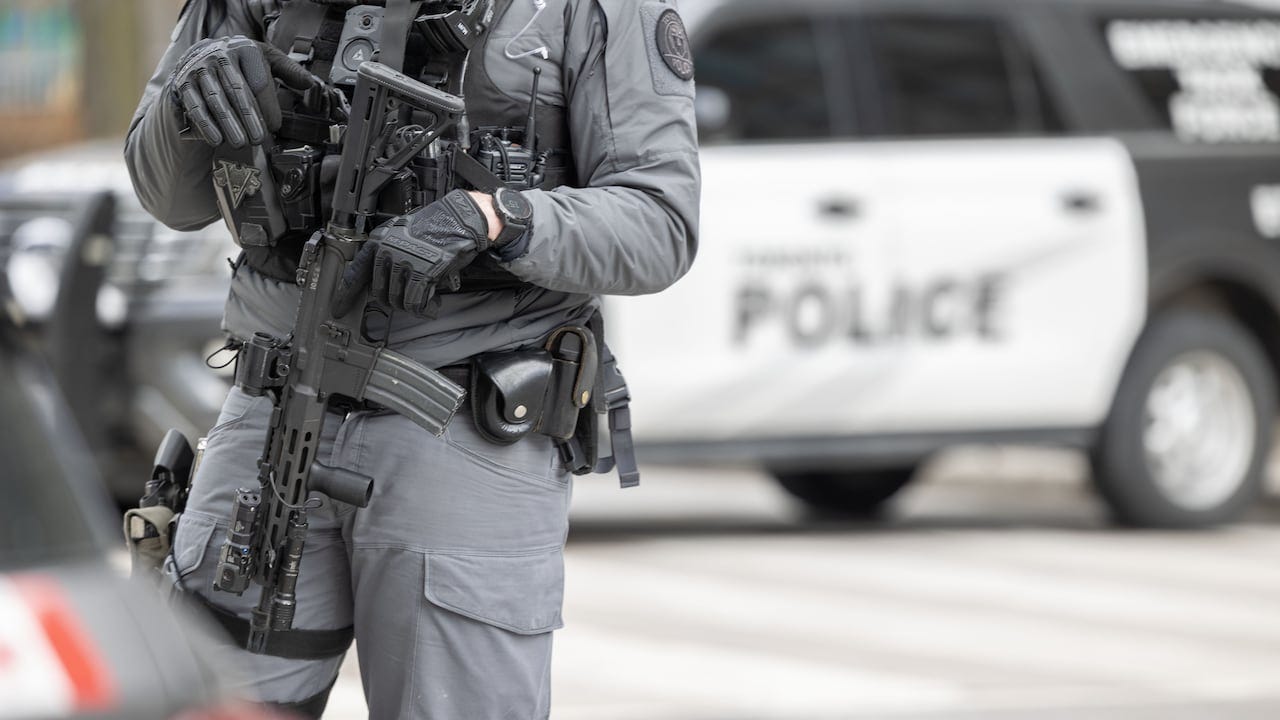
The image of heavily armored police officers, armed with semi-automatic long rifles, sweeping through the quaint streets of Toronto is a novel sight for many residents, though the cities top brass informs us that it is absolutely necessary— Police Chief Myron Demkiw said the newly created counter-terrorism security unit and “task force guardian” are not being set up in response to any one threat but are security measures to “prevent, detect and disrupt” extremism violence and terrorism.
The establishment of a new counter terrorism unit comes amidst a peculiar time in Canadian discourse. On March 11, the federal government announced a $10 million investment in the Canada Community Security Program (CCSP), specifically aimed at supporting the “work of operations centres to coordinate monitoring and security at Jewish institutions, as well as projects supported through this institutions”. The funding comes in response to a spat of hate-motivated incidents in the week prior; three separate synagogues in the Greater Toronto Area (GTA) were hit by gunfire between March 2 and March 7. Though police say the incidents are unrelated to each other, they have yet to release any information on a suspect or lead.
Thankfully, in all three cases, nobody was injured in the overnight shooting. However, under the current CCSP guidelines, the incidents qualify the respective synagogues for priority assessment — To be eligible for a priority assessment, organizations must have had…a severe incident related to a hate or bias-motivated crime resulting in bodily harm, injury, death, and/or significant threat of physical violence (e.g. presence of armed intruder). Ottawa has also earmarked an extra $11-million annually through the CCSP, which has approved $7.3 million for 143 projects to help protect Jewish communities since its launch.
Additionally, to completely and unquestionably ensure the safety of Toronto’s Jewish community, police say they are banning protests in residential parts of a North York Jewish community that has seen regular demonstrations in recent years. “Due to the changing security landscape in Toronto in recent weeks, including increased volatility and heightened fear in our communities, demonstrations moving into residential neighbourhoods in the Bathurst and Sheppard area presents an unacceptable risk to public safety” wrote Toronto police spokesperson Stephanie Sayer in a statement.
Tens of millions in funding for security upgrades, armored police sweeping the streets for potential terrorists, sudden and strict limitations on peaceful assembly, all mobilized in an efficiency unforeseen at the bureaucratic level— but some say it’s not enough. The Centre for Israel and Jewish Affairs (CIJA), one of the largest Jewish and Zionist advocacy organizations in Canada, recently sent a letter to federal Finance Minister Francois-Philippe Champagne saying additional money is urgently needed after national security reports a violent extremist attack against Canada’s Jewish community is a “realistic possibility” in the next six months; “Amid the war in Iran and the fallout from the Israel-Gaza conflict, ITAC [Integrated Threat Assessment Centre] assessed that the Canadian Jewish community – including schools, community centres and synagogues – is in danger.” In it’s report, ITAC said that the longer the U.S.-Israeli war on Iran continues, likelihood that the Canadian Jewish community will face backlash.
In the letter, CIJA chief executive officer Noah Shack said that Jewish communities have had to spend an estimated $40-million annually on security; “No other community in Canada is required to bear such a burden to ensure basic safety”. Contrary to Mr. Shack’s obviously well-intentioned words, it’s hard to ignore the clear discrepancy in prioritization between Jewish and Muslim communities by the power of the state.
Over a four-year period between 2017 and 2021: a gunman killed six and wounding 19 worshippers at the Islamic Cultural Center of Quebec, a Muslim volunteer was stabbed in the neck while sitting outside a mosque by a man obsessed with neo-Nazi satanic content, and three generations of a family were snuffed out—leaving a nine-year-old boy to be orphaned—when a man intentionally struck them with his pick-up truck. Based on the investigation by police, Chief Steve Williams told reporters the next day that “We believe the victims were targeted because of their Islamic faith.”
Over the years, Muslim woman have been subjected to acts of physical violence, particularly those who wear the hijab or niqab openly. As recently as April 16, an incident on a Durham Region Transit bus was captured on video depicting a man kicking another female passenger wearing a hijab and calling her a “terrorist”. According to reports, the only other passenger who stood up for the victim was another woman wearing a hijab.
In all cases mentioned above, there was nowhere near the level of response or mobilization by the state on behalf of the Muslim community. There were no multi-million dollar funds made eligible specifically for Muslim places of worship or any anti-terrorism task force deployed to protect Muslim areas. In the year the Quebec mosque shooting took place, the federal government funded only two projects to install security systems inside the Ottawa Muslim Association’s headquarters on Northwestern Avenue and their Hall of Peace— an endeavor totaling $46,000.
In the case of those organizations that do meet the threshold for increased security funding, the process of obtaining said funds is another battle entirely. Stephen Brown, chief executive officer of the National Council of Canadian Muslims, said the major concern within the Muslim community is delays in CCSP approvals; “Right now, applicants like mosques and community centres are waiting for months if not over a year for a response to their applications.” A stark contrast to the timely and overwhelmingly positive response to the concerns of Toronto’s Jewish community who, according to Public Safety Minister Gary Anandasangaree, have received over 70% of CCSP funding.
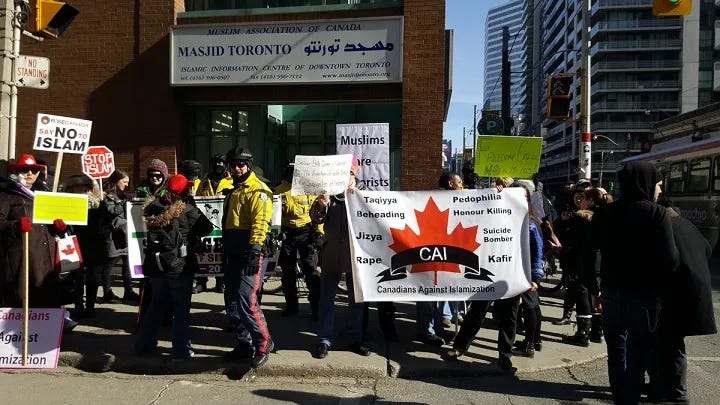
In fact, a month after the 2017 Quebec mosque shooting, a group of “up to 50 protestors” marched to a mosque at Adelaide and Church while holding signs that read “Say No To Islam,” “Ban Islam,” “Muslims Are Terrorists” and “Less Islam Brings Less Terror No Islam No Terror.” The protest was organized amidst Parliamentary debate on Motion 103 (M-103), a non-binding motion stating that the members of the House of Commons called on the Government of Canada to condemn Islamophobia in Canada. A tepid and arguably insufficient response to one of the worst mass shootings in Canadian history at the time, M-103 roused the ire of Jewish advocacy groups like CIJA, who accused the motion of singling out one religion for special treatment and of quashing all criticism of Islam, and B’nai Brith Canada, the country’s oldest Jewish service organization, who offered the Standing Committee on Canadian Heritage a list of specific recommendations to adopt;
“a) The Committee should endorse the systematic analysis of data on religiously-based hate crimes (B’nai Brith’s Annual Audit of Antisemitic Incidents could serve as a major contribution to this effort);
b) The Committee should support an education campaign to promote understanding of the societal threat from hatred and discrimination based on religion; and
c) The government should create and expand opportunities for dialogue, tolerance training and cross-community partnerships.”
The website link to CIJA’s official statement on M-103 seems to no longer be active.
In April, the Quebec government passed Bill 9, An Act respecting the reinforcement of laicity in Quebec (laicity is a principle of strict secularism). The act bans prayers on public spaces such as streets and parks, eliminates prayer rooms in public institutions (including universities), requires having one’s “face uncovered throughout the entire publicly-funded educational system, and prohibits “wearing religious symbols for staff members of childcare centres, subsidized private daycares, and home-based childcare service coordinating offices.
You’d think that CIJA, a Canadian religious advocacy group, would outright reject this attempted infringement on the religious freedoms of Canadians. Yet, CIJA has “largely welcomed Quebec’s passage of Bill 9”. According to CIJA officials “the explosion of antisemitism, extremism, and Islamism is no longer theoretical — it is being experienced in our streets and on our campuses. [Bill 9] better protects places of worship against threats with the introduction of buffer zones” and welcomed the fact that covered faces “no longer have a place in our educational institutions.” The organization praised the fact that “the instrumentalization by radical Islamists of street prayers is finally recognized as totally contrary to our societal model and clearly regulated.”
Well, technically, I guess CIJA did express some discontent with the language of Bill 9:
“However, with regard to private schools, we are still troubled by the fact that the government continues to target the wrong issue. Private schools — and Jewish schools in particular — are non-profit organizations and models that actively transmit Quebec values. They are not the problem. They are part of the solution.”
Advocacy groups like CIJA posture themselves as tolerant of their fellow Muslim countrymen when it’s politically expedient but their underlying insistent messaging is clear; Jewish communities in Canada can never feel truly safe until Muslims are expelled, and the safety of Canada’s Jewish communities should come before all.
Yet, the truly insidious work of organizations like CIJA and B’nai Brith Canada doesn’t simply boil down to their scapegoating of Muslim-Canadians, but their utilization of these scapegoats in their long standing commitment to the Israeli settler project.
Neither the letter penned by CIJA to the Minister of Finance, nor the media reports on the March shooting incidents themselves, makes any mention of the work these synagogues (Temple Emanu-El synagogue, Beth Avraham Yoseph of Toronto, and Shaarei Shomayim synagogue) have done to support the Israeli siege on Gaza and, in some cases, the expansion of illegal settlements in the West Bank.
Temple Emanu-El synagogue supports Israel through initiatives like their “Peace of Mind” program, which helps IDF veterans process combat trauma, though the connections get more troubling.
GTA to IDF is a documentation project from Davide Mastracci, the opinion editor of The Maple online newsletter. The purpose of the project is to document the Canadian institutions that are significant contributor of “lone soldiers” to the Israeli military. According to the GTA to IDF website;
These soldiers come exclusively from Canada’s Jewish communities, as they are the only ones able to immigrate to Israel solely on the basis of their ethnoreligious background. As of 2021, about half of Jewish Canadians lived in Toronto. The Find IDF Soldiers project found that the average lone soldier is “most likely to have grown up in a Greater Toronto Area neighbourhood with a larger-than-average proportion of Jewish residents in what they’d describe as a Zionist household.”
The profile of institution was added to the project’s directory if it and/or its head office is based in the GTA and it’s associated with at least four military members contained in The Maple’s Find IDF Soldiers database. The project defines ‘associated” as an individual having attended, spoken or worked at an institution.
Profiles for both Beth Avraham Yoseph of Toronto (BAYT) and Shaarei Shomayim synagogue appeared on the GTA to IDF project page. While association with a soldier doesn’t necessarily mean the institution condones the actions or viewpoints of the soldier, both BAYT and Shaarei Shomayim are heavily involved in IDF activities.
In December 2023, Shaarei Shomayim synagogue advertised an event called the “Shaarei Shomayim Mission to Israel,” which is described as, “A mission of understanding, solidarity, and unwavering support.” The mission’s itinerary included barbequing for soldiers and “packing essential items for the front lines and victims.” In January 2024, the synagogue hosted an event where the grandparents of an Israeli military member serving in Gaza spoke about his experience.
BAYT has been the site of protests in recent years after an event billed as “The Great Israeli Real Estate Event” was held at the synagogue in 2024. The event offered attendees legal and financial advice regarding moving to Israel — or to a few settlements in the occupied West Bank. The vast majority of the international community, including Canada, considers the establishment of settlements in the occupied West Bank and Gaza as illegal under international law. The UN Security Council and the International Court of Justice (ICJ) have affirmed this position, stating they have no legal validity.
Therefore the work that groups like CIJA and B’nai Brith Canada do is twofold; simultaneously vilify Canadian Muslims under the guise of personal safety (or the vague tangential feeling of personal safety) while obfuscating the link between Canadian Jewish institutions and their military and economic support for Israeli settlements, even when this support is in direct violation of international law. Sometimes these two goals overlap, like when CIJA expressed discontent with the government’s decision to grant visas to 5,000 residents of Gaza who are related to Canadian citizens over “national security concerns”.
I truly detest the liberal game of political “whataboutism”, but its hard to believe any mosque in Canada would have the freedom to raise millions in funds for the illegal establishment of settlements in a foreign nation, or send hundreds of Canadian citizens to serve in a foreign army led by individuals who, by admission of the Prime Minister himself, would be arrested if they stepped foot in Canada. Public sentiment might be slightly different if it was revealed that multiple mosques across the country were financial and military strongholds of the Houthis or the Taliban.
Yet, in the case of the Canadian Jewish community, they’re rewarded tens of millions of dollars in security funding and small paramilitary units organized to ensure they feel safe during their illegal land auctions.
As always, Canada refuses to afford Palestinians or Muslims the same level of decency or respect. Reports of Toronto police showing up at peaceful pro-Palestine events point to a broader strategy of intimidation on behalf of the pro-Zionist community; on April 4, police showed up to the Stand-up For Gaza comedy show and disrupted a film screening of Palestine 36 on the same evening.
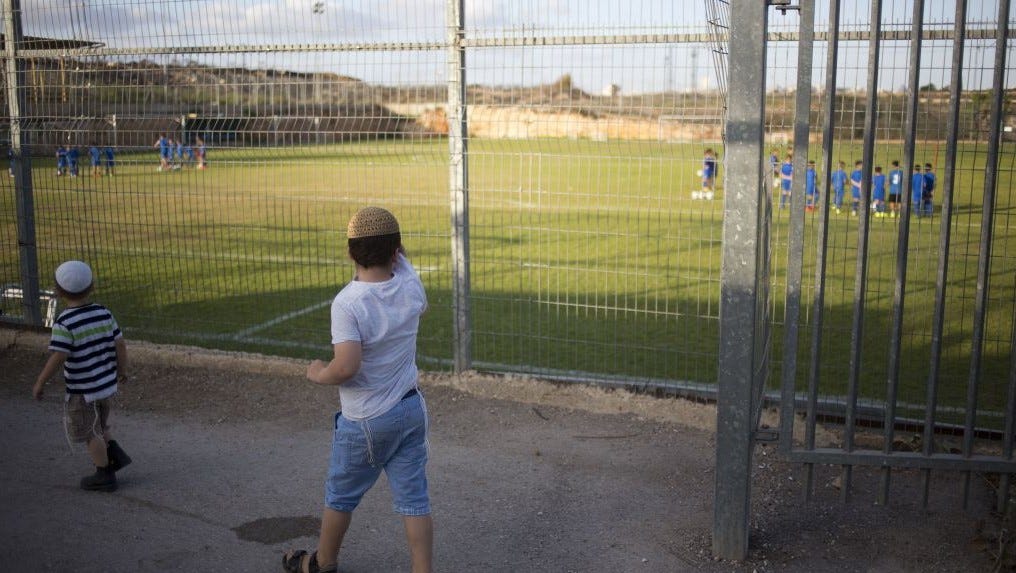
Furthermore, after FIFA (which is set to be partly held in Canada this summer) announced that it would take no action against Israeli soccer clubs accused of competing while allegedly being illegally based in Palestinian territory (wrongfully claiming “the final legal status of the West Bank remains an unresolved and highly complex matter under public international law”), the Palestinian Football Association announced that three of their officials have had their applications for visas to enter Canada rejected.
This decision comes right before the annual FIFA Congress set to take place in Vancouver on April 30, which is seen as an unofficial kickoff to the World Cup. Palestinian officials had also hoped to use the event to address the issue of Israeli football clubs playing competitive matches in occupied Palestinian territory in the West Bank — in explicit violation of the organizations own rules that prohibit member associations and their clubs from playing on the territory of another member association without the latter’s approval.
Zionist advocacy groups continue foment fear against Muslims, characterizing them as a fifth column, ready and willing to subvert the idyllic Canadian nature that Jews have helped establish. Morbidly, they employ the same antisemitic tropes traditionally hurled towards their own communities and repurpose them for a new age and a new perceived enemy; accusing Muslims of a secret seditious “dual-loyalty”, spreading fears of “sleeper cells” during the height of a war of aggression on a Muslim country, and welcoming strict legislation meant to strip Muslims not only of their religious freedoms but their dignity and collective self-esteem.
There has been a long Jewish-Canadian campaign of Muslim dehumanization ever since Quebec’s push for bi-culturalism evolved into the cultural pluralism of today. David S. Koffman, an associate professor in the Department of History at York University, and Editor-in-Chief of Canadian Jewish Studies, wrote about the change in challenges for Canadian Jews over time, particularly since October 7;
“But the biggest change is not one internal to the Jewish experience. It’s an ideological transformation in Canada at large. Multiculturalism, once the ideological baseline of Canadian self-understanding, has quietly retreated. In its place have risen two key ideological and policy frameworks: Equity, Diversity, and Inclusion (EDI) and Indigenous Reconciliation…These frameworks present new challenges for Canadian Jews—challenges far more complicated than multiculturalism ever did…Fairly or unfairly, proponents of EDI often do not see Jews as “equity-seeking,” since today’s Jewish community does not appear to face systemic barriers to equal access to opportunities in employment, education, or other social benefits…”
In response to this change in social dialectic, Koffman claims that
“For decades, as networks of solidarity among Black, Indigenous, and other visible minority Canadians—including Arab and most Muslim Canadians—strengthened, Canadian Jewish communal resources increasingly moved away from what was once called “community relations” (and is now called “allyship”). Instead, we invested in vertical alliances: forging strong ties with police chiefs, university presidents, Members of Parliament and Members of Provincial Parliaments, and other officials.”
Koffman’s explanation succinctly describes the discrepancy I’ve spent an article trying to highlight; Jewish communities have spent decades and untold millions translating their material resources into preferential policy that vilifies pro-Palestinian “EDI” spaces. During times of relative peace these policies are virtually invisible, lying dormant until they need to be dusted off and utilized. But October 7 changed that. The thick woven cultural mosaic that used to define Canada is unravelling, and Canada’s Muslim community will have to reconcile with their incredibly tenuous position in this country. Should the state need to choose between it’s Jewish or Muslim communities, I fear the decision won’t be difficult.
At the end of last year, Benjamin Netenyahu announced a new “eighth front” added to the list of seven war-fronts Israel faces (Gaza, West Bank, Lebanon, Yemen, Iraq, Iran, and Syria). The new eighth-front was the fight against “misinformation” in the West, a.k.a “the ‘battle for truth’, in order to win back hearts and minds”. That is the war being fought on our very doorstep in Canada. A rhetorical war that seeks to decouple the heaps of misery thrown onto Palestinians from it’s perpetrators abroad. A war that seeks to surveille Palestinian film premiers and fundraisers. A war that ultimately seeks to erase Muslims from public life in Canada.
P.S.
Former PM Stephen Harper’s firm pours $350M into developing military tech for Israel