
I no Black, I Black!
Beyonce’s low racial self-esteem and the emergence of Foundational Black Americans

As a demarcation, ethnicity or ethnic subgroup is the skeleton that all of modern history is built around. The etymology of polities can’t generally be traced to religious or gendered groups, but they can be traced to the legacy of ethnic groups. It remains the only language that we, as a species, use to legitimize claim to land and, despite our best efforts, is the only claim that matters. As can be heard on a public service disc from the 1970’s titled The Dialect of Black Americans, “…it is surely time that the speech of the Black culture of America be recognized as a genuine dialect of English. It is, in every sense of the word, a dialect.”
Indeed, it has surely long been time to consider the African-American Negro, the American Descendants of Slavery (ADOS) or the Black American, as a genuine ethnicity, no different from the Igbo of Nigeria, the Xhosa of South Africa, or the Amhara of Ethiopia. They are, in every sense of the word, an ethnicity. That their birth was the result of the machinations of cultural thieves and their increasingly industrialized greed makes them no different from the endogamous nature of other groups across continental Africa (and non-continental Africa). From its inception, Pan-Africanism has conceptualized the diaspora as the crux, from the African born in Saint Anne Parish to the African born in Três Corações. The enduring legacy of African-Americans should be a self-evident pillar of Pan-Africanism; instead, we’ve found ourselves in a highly atomized ‘afro-isolationist’ ideological age.
If the Pan-African movement died with Malcolm, Black America has spent the time since doing a sort of soul searching, decades of trying on different ideological hats in an attempt to self-actualize and fill the gap left by its death. As many identities as there have been, from afro-pessimists to Black Israelites (what tribe are you from?), a peculiar movement has recently taken root in Black American e-discourse, positioning itself, not as a global ideology connecting Africans, but a domestic ideology rejecting Africa. Foundational Black Americans (FBA), as described on their website, is a “lineage-based designation that specifically refers to the over 43 million Black Americans who are direct descendants of the Freedmen — the formerly enslaved Black people who were emancipated in the United States.” To their credit, the ADOS Advocacy Foundation Website lays out expansive policy pillars with a focal point on the consequences of chattel slavery for it’s descendants while advocating for all “Black Americans” (except for the notable call for reparations of $20 trillion, which the website believes should be allocated for descendants of freed slaves).
The only section of the “Black Agenda” that seems noticeably scant compared to parallel policy directive is the section on immigration. Two calls to action appear across two paragraphs; the mandatory inclusion of Black American History on the Naturalization test for new immigrants, and adherence to a “needs-based approach when allocating the number of H1-B Visa workers for tech companies that flow in each year.” Until then, the ADOS Advocacy Foundation will reject and oppose outright all legislation and executive action around immigration reform. No historical analysis of African immigrant contributions to the Black American struggle for self-determination, no allusion to re-forging a African-ADOS link fractured by the Trans-Atlantic slave trade, no construction of immigrants as a class beyond antagonistic towards the progression of Black Americans. Therein lies the distinguishing feature of the FBA/ADOS designation — a self-interest that rejects categorization with recent Black African immigrants and Black immigrants from the Caribbean.
The recent rise in ADOS sentiment conveniently coincides with the Trump administrations rise in public hostilities towards immigrant communities in the US. On August 12, hundreds of national guard troops flooded D.C. as part of the President’s directive to “combat violent crime” in the city, of which agents from ICE’s Enforcement Removal Operation were a key part. According to a spokesperson for ICE, an operation at a Home Depot “resulted in arrests of criminal illegal aliens convicted of assault, theft, and gang activity”. Where a decade ago we would see widespread defense of immigrants from Black e-discourse sellers, the small but vocal sect of FBA’s seem to be reveling in the state apparatus terrorizing over-exploited migrants.
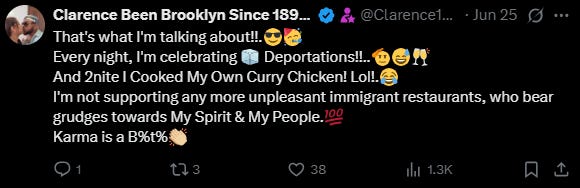
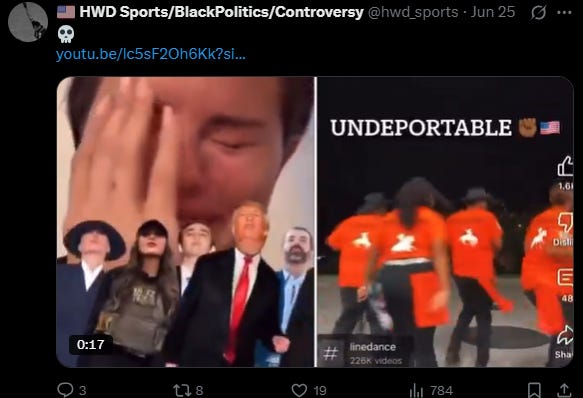
ADOS movement co-founder Yvette Carnell, a former aide to Sen. Barbara Boxer (D-Calif.) and Rep. Marion Berry (D-Ark.), was previously a board member of Progressives for Immigration Reform (PFIR), a group described by InfluenceWatch as advocating “for restricting illegal and many forms of legal immigration to the United States.” PFIR is one of many organizations that comprise the “Tanton network”; a coalition of “bipartisan” organizations dedicated to combating all forms of immigration, united by their loose relationship to and funding by pro-eugenics white nationalist John Tanton. These organizations include the Center for Immigration Studies (CIS), Federation for American Immigration Reform (FAIR), Social Contract Press, and the Coalition for the Future American Worker. In fact, it was ADOS movement co-founder Antonio Moore who popularized the anti-immigrant rhetoric accusing former Presidential candidate Kamala Harris of claiming the “struggles of people who have been here chained to chattel slavery for multiple generations…” due to her father being of Jamaican ancestry (a claim which would later be amplified by Donald Trump Jr. during the 2024 election).
In a way, the ADOS movement has succeeded in arousing a bipartisan aura despite their clear conservative leanings; over a thousand were in attendance at the group’s first national conference to witness a panel of guests speakers that included former Democratic Presidential candidate Marianne Williamson, and Harvard University professor Cornel West — who has claimed that ADOS is a working class movement of Black Americans. It’s clear that, despite their minimal membership, the rhetoric of the ADOS movement has struck a chord with Black Americans who don’t have a “homeland” to return to in the same way that Black immigrants do. Generations of Americans who are able to trace their lineage through civil rights leaders and Black Panther members all the way to stolen Africans brought to America, producing a culture born of subjugation but, simultaneously, inherently attached to the land that subjugated it. Any attempt to ignore this truth while addressing the plight of ADOS results in the replication of European colonizing patterns, such as the case of Americo-Liberians or freedman settlers. What’s emerged is a culture of ethnonymic resentment towards terms like “African American”; rejecting Africa for an embrace of America. Tangentially connected to this culture of resentment are various niche online communities dedicated to proving that modern Black Americans are, in fact, descendants of a multitude of potential groups except Sub-Saharan Africans; the original 12 Tribes of Israel, Indigenous American communities, and ancient Egyptians, to name a few.
As it always has, pop culture has quickly caught up to this shift in Black American political identity, looking to commercialize on Black attachment to Americana — particularly in the realm of country music. Over the last few years, from Lil Nas X to Shaboozey, country music has seen a sharp rise in visibility for Black artists; highlighting the contributions made by Black Americans in the genres of bluegrass, folk, and country, as well as the inextricable link between southern cowboy culture and the legacy of American slavery in the south. In tandem with the ADOS movement, what has resulted is a serious demand for art that meaningfully engages with the significant and often downplayed contributions made to dominant culture by American descendants of slaves — a demand that can only be met by one mononym above all.
Enter stage right, Beyoncé. Her eighth studio album, Cowboy Carter, has continued to break records (including spawning the highest-grossing country tour in history) cementing her place at the helm of the Black cowboy renaissance (no pun intended). She even performed at the inaugural 2024 NFL Christmas Day Halftime Show, aptly dubbed “Beyoncé Bowl”; a meticulously choreographed homage to Texan rodeo culture, Juneteenth celebrations, and historically Black colleges and universities — a feat of proportions so awesome, only Beyoncé could pull it off. Yet, in the heat of the Cowboy Carter journey, amidst the clouds of rodeo dirt and loose crimson petals, riding high atop a pale stallion beside the rodeo queens of all rodeo queens, one must ask; why? Why now? What must have compelled Beyoncé to choose this moment in time to stake her claim in the American dream?
If the name “Beyoncé” were to have a singular literary equivalent, the closest would be some sort of synonym for intentional or methodical. Every single one of her creative outputs — from her recorded musical performances and music video cinematography to her stage design during live performances and her associated merchandise design — is meticulously crafted to convey an emotion, an allegiance or a moment in time. She has an immaculate ability to connect historical significance with vulnerable personability and present it all against the theatrical backdrop of one of the greatest voices in modern music. She was the every-woman on I Am… Sasha Fierce channeling the feminine dichotomy through her alter ego, she was the scorned-lover Negro Creole descendant of Black Panther resistance fighters on Lemonade, she was the Pan-African Garveyite emphasizing global Black unity through her work on The Lion King remake soundtrack album Black is Love, she then planted her flag in the long history of Black contributions towards house music and electronica through her initial entry in an ongoing trilogy, the queer-inspired Renaissance. If there ever was an artist who spoke to the complex legacy of Black Americans and their relationship to cultural self-actualization, it’s Beyoncé.
So who is Beyoncé now? Well, a recent controversy might shed light on the source of inspiration for her embrace of Americana. During a Juneteenth performance on her Cowboy Carter tour, Beyoncé donned a t-shirt (admittedly still looking great after enduring 25 years of stress in the business) emblazoned on the front with images of the Buffalo Soldiers; a 19th-century military regiment entirely composed of Black soldiers who served on the American frontier. The back is a lengthy description of their origin and contribution to the expansion of the American frontier, overcoming any and all opponents in their path — except the “twin foes” of prejudice and discrimination from country that had fought a bloody war to keep them subjugated in chains only a generation prior.
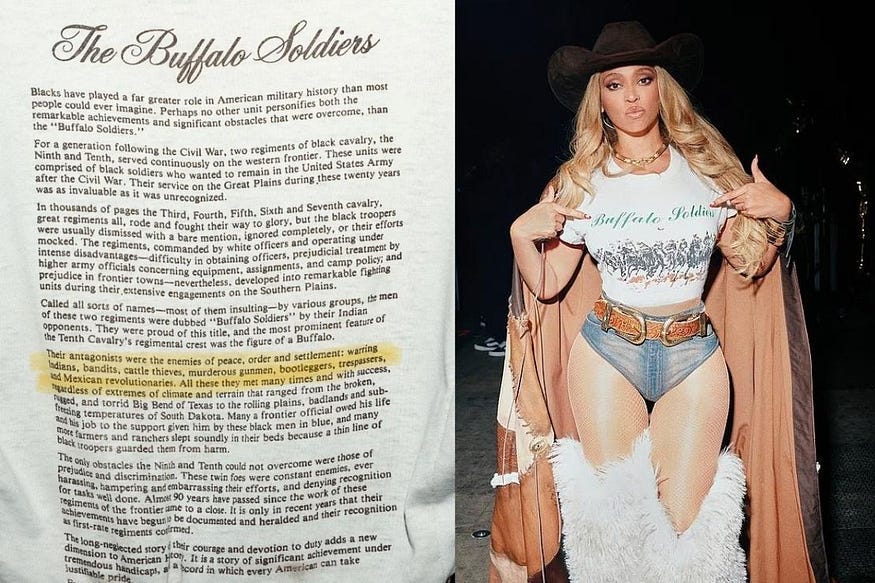
An overall faithful description of the regiment’s history, the sentiment begins to raise eyebrows as Beyoncé (and we have no reason not to credit her as the primary voice behind this diatribe) describes who is among the enemies of the Buffalo Soldiers, alongside the woes of prejudice and discrimination. She doesn’t point the finger at a systemic project of displacement that forces freed slaves to kill for their humanity (she does recognize the “intense disadvantages” these soldiers faced in “obtaining equipment, assignment, and camp policy; and prejudice in frontier towns”), rather the antagonists of peace, order and settlement were “warring Indians, bandits, cattle thieves, murderous gunmen, bootleggers, trespassers and, Mexican revolutionaries”. She even describes their namesake as being coined from a potential insult hurled by their “Indian opponents”.
While I wouldn’t accuse Beyoncé of harbouring any animosity towards immigrant communities, it does seem odd that, during a time when the American government is seeking to transform ICE into an omnipresent all-powerful authority through the integration of a mass AI-powered Thiel-funded surveillance database and public shows of violent mass deportations, Beyoncé would want seemingly ride the wave of anti-immigration hysteria promoted by ADOS and FBA advocates by trying to co-opt the colonization of Indigenous and Mexican land into a progressive, cultural touchstone for Black Americans. In reality, the so-called warring Indians and Mexican revolutionaries were rebelling against the same foreign, exploitative entity that ultimately violated the ancestors and progeny of these very soldiers. The attempt to earn recognition of humanity through dedication to military service is as futile as the attempt to de-racialize policing from within. Would the displacement of Indigenous peoples, then, be made moral had these soldiers been granted treatment equal to that of their white settler peers? Would the self-victimization of American settlers justify the annexation of rightfully Mexican land if more of them were Black? Would the Trans-Atlantic Slave Trade, and all it’s consequences therein, be justified if the slaves were reassured their lineage would earn freedom through colonization?
Virtue cannot be discerned from lineage, and any attempt to demand the spoils of a colonial project requires you to demand an equal share of the blood as well. In truth, this t-shirt debate won’t even register on Beyoncé’s radar. What will endure, however, is the consequences of a paleo-patriotic movement emboldened by techno-weaponizing the American flag, little by little, against those groups whose utility towards the colonial project have run out, beginning with those who have the least legal protections. The earnest dedication made by the descendants of slaves towards the project will net them very little except a slightly more scant audience at their inevitable execution, seeing as all the warring Indians and Mexican revolutionaries were dealt with long ago.